
> C++ > Standard Template Library (STL) > Accelerate STL Algorithms with Parallel Execution Policies
Accelerate STL Algorithms with Parallel Execution Policies
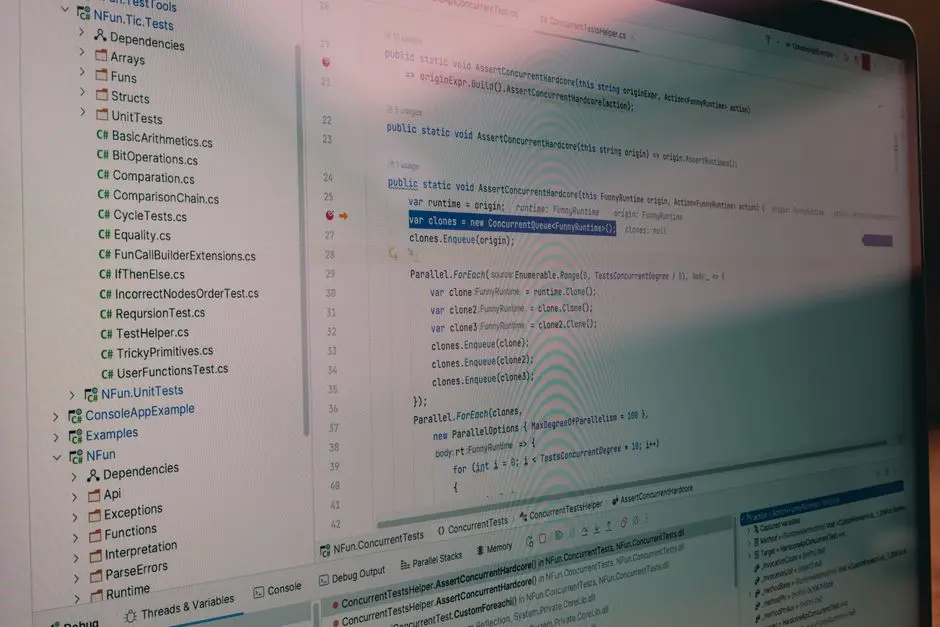
Unlock the formidable power of modern multi-core processors by mastering C++ Standard Template Library (STL) parallel execution policies. We stand at the frontier of high-performance computing, where harnessing concurrency for algorithmic operations is no longer optional—it's imperative. This article decodes how to activate automatic multi-threading for your STL algorithms, primarily leveraging std::execution::par. Prepare to transform sequential code into blazing-fast parallel operations with minimal effort, revolutionizing your application's responsiveness and computational throughput. We navigate the intricacies of parallel execution, empowering you to forge applications that scale effortlessly across diverse hardware. This exploration provides the critical insights required for optimizing your STL container and algorithm usage to its fullest potential, ensuring your code executes with unparalleled efficiency. Dive deep to conquer the complexities, avoid common pitfalls, and engineer a paradigm shift in your C++ development strategy.
Unlocking Parallelism: The Core Concepts
We embark on a journey to decode the fundamental principles of parallel execution in the C++ Standard Template Library. Prior to C++17, all STL algorithms operated sequentially, constrained by a single thread of execution. The advent of C++17 introduced a revolutionary paradigm: execution policies. These policies empower us to dictate how an algorithm performs its operations, specifically enabling automatic multi-threading without requiring explicit thread management. This innovation significantly elevates our capacity to leverage modern multi-core processors, transforming computationally intensive tasks from bottlenecks into accelerators.
The <execution> header reveals the toolkit. We primarily encounter three distinct policies:
std::execution::seq: This policy enforces sequential execution. It mirrors the pre-C++17 behavior, ensuring operations proceed one after another in a single thread. We use it for clarity or when parallelism introduces unwarranted overhead.std::execution::par: This is our gateway to automatic multi-threading. When applied, the algorithm orchestrates its operations across multiple threads, leveraging available hardware concurrency. The order of non-interfering operations becomes indeterminate, but the overall effect on the data remains consistent with sequential execution. We activateparto achieve significant speedups for algorithms processing large datasets.std::execution::par_unseq: This policy combines parallel execution with vectorization (unsequenced execution). Beyond multi-threading, it permits operations on individual elements to be performed concurrently and reordered within a single thread, potentially exploiting SIMD (Single Instruction, Multiple Data) instructions. This offers the highest potential for performance gains but demands stricter adherence to non-interference rules, especially regarding memory access.
Our initial focus for accelerating algorithms centers on std::execution::par. It provides a robust, generally safe, and highly effective mechanism to distribute workload. We apply this policy as the first argument to any parallel-enabled STL algorithm, transforming its execution model from serial to concurrent. This simple syntactic addition unlocks a new dimension of performance, allowing our applications to scale with processor core counts. The included code example demonstrates this transformation using std::for_each, illuminating the dramatic difference in execution time between sequential and parallel processing for a large dataset. We observe directly how par engineers a substantial reduction in computational latency.
/*
 * Compile with C++17 or later, ensuring parallel execution support is enabled.
 * Example for g++: g++ -std=c++17 -O3 -pthread your_file.cpp -o your_program
 * For clang++: clang++ -std=c++17 -O3 your_file.cpp -o your_program
 */

#include <vector>
#include <algorithm>
#include <execution>
#include <iostream>
#include <chrono>
#include <numeric>

void run_example_core_concepts() {
    // Forge a large dataset for meaningful benchmarks
    const size_t data_size = 100000000; // 100 million elements
    std::vector<int> data(data_size);
    std::iota(data.begin(), data.end(), 0); // Fill with sequential values

    std::vector<int> data_seq = data; // Copy for sequential execution
    std::vector<int> data_par = data; // Copy for parallel execution

    // 1. Measure Sequential Execution (std::execution::seq - default behavior)
    auto start_seq = std::chrono::high_resolution_clock::now();
    std::for_each(std::execution::seq, data_seq.begin(), data_seq.end(), [](int& n) {
        n = n * 2 + 1; // Perform a simple operation
    });
    auto end_seq = std::chrono::high_resolution_clock::now();
    std::chrono::duration<double> duration_seq = end_seq - start_seq;
    std::cout << "Sequential execution time: " << duration_seq.count() << " seconds.\n";

    // 2. Measure Parallel Execution (std::execution::par)
    // This activates automatic multi-threading for the algorithm.
    auto start_par = std::chrono::high_resolution_clock::now();
    std::for_each(std::execution::par, data_par.begin(), data_par.end(), [](int& n) {
        n = n * 2 + 1; // Perform the same operation
    });
    auto end_par = std::chrono::high_resolution_clock::now();
    std::chrono::duration<double> duration_par = end_par - start_par;
    std::cout << "Parallel execution time: " << duration_par.count() << " seconds.\n";

    // Validate results (optional, for simple operations)
    // For this simple operation, both should yield the same result if `data` started identical.
    // Note: for_each modifies in place, so simple validation is hard without comparing vectors.
    // For demonstration, we just show timings.
}

int main() {
    std::cout << "Executing Core Concepts example...\n";
    run_example_core_concepts();
    return 0;
}
Engineering Performance: Diving Deeper into par and par_unseq
We penetrate deeper into the architecture of parallel execution, contrasting std::execution::par and std::execution::par_unseq to precisely engineer performance gains. While par orchestrates operations across multiple threads, par_unseq extends this by permitting unsequenced operations within each thread. This implies that not only can different elements be processed concurrently by different threads, but also operations on distinct elements processed by the same thread can be reordered and potentially vectorized using SIMD instructions. This strategy yields the highest potential for acceleration on algorithms where operations are truly independent and lack strict ordering requirements.
A critical distinction emerges concerning data races and thread safety. When employing std::execution::par or std::execution::par_unseq, we must guarantee that operations on distinct elements do not interfere with each other. This means avoiding shared mutable state unless protected by robust synchronization mechanisms (e.g., atomics, mutexes). If multiple threads or vectorized operations modify the same memory location without proper coordination, undefined behavior ensues. The beauty of parallel STL is its focus on algorithms operating on ranges, where each element's processing is typically independent, mitigating many data race concerns inherently. However, if a lambda captures and modifies an external variable, we introduce a shared state, demanding careful synchronization.
The underlying execution model typically involves a thread pool. When an algorithm is invoked with a parallel policy, the STL implementation internally distributes the workload across a pool of threads. These threads might employ work-stealing algorithms to ensure load balancing, dynamically assigning tasks to idle threads. This abstraction empowers us to focus on the algorithm's logic rather than the intricate details of thread management. For instance, a std::transform applied with par_unseq on a large vector will partition the vector, assign chunks to different threads, and within each chunk, those threads might apply SIMD instructions to process multiple elements simultaneously.
The provided code example meticulously benchmarks std::transform and std::sort with std::execution::seq, std::execution::par, and std::execution::par_unseq. For std::transform, which performs element-wise operations, par_unseq often delivers superior performance due to its vectorization capabilities. For std::sort, which has more inherent data dependencies, par typically offers significant speedup over seq, but par_unseq's benefits might be less pronounced or even unavailable depending on the specific standard library implementation. We analyze these benchmarks to understand the practical implications of each policy, affirming that judicious selection is paramount for optimal performance engineering.
/*
 * Compile with C++17 or later, ensuring parallel execution support is enabled.
 * Example for g++: g++ -std=c++17 -O3 -pthread your_file.cpp -o your_program
 * For clang++: clang++ -std=c++17 -O3 your_file.cpp -o your_program
 */

#include <vector>
#include <algorithm>
#include <execution>
#include <iostream>
#include <chrono>
#include <numeric>
#include <random>
#n// Function to run a benchmark for a given policy and algorithm
template<typename Policy, typename Func>
void benchmark_algorithm(Policy&& policy, const std::string& policy_name, const std::string& algo_name, Func&& func) {
    std::cout << "\nBenchmarking " << algo_name << " with " << policy_name << "...\n";
    auto start = std::chrono::high_resolution_clock::now();
    func(policy);
    auto end = std::chrono::high_resolution_clock::now();
    std::chrono::duration<double> duration = end - start;
    std::cout << "  " << algo_name << " (" << policy_name << ") time: " << duration.count() << " seconds.\n";
}

void run_example_deep_dive() {
    const size_t data_size = 50000000; // 50 million elements
    std::vector<double> data(data_size);
    std::mt19937 gen(0); // Fixed seed for reproducibility
    std::uniform_real_distribution<> dis(-100.0, 100.0);
    std::generate(data.begin(), data.end(), [&]() { return dis(gen); });

    // Demonstrate std::transform with different policies
    std::vector<double> results_seq(data_size);
    std::vector<double> results_par(data_size);
    std::vector<double> results_par_unseq(data_size);

    // Transformation: calculate sine of each element
    auto transform_op = [](double x) { return std::sin(x); };

    benchmark_algorithm(std::execution::seq, "std::execution::seq", "std::transform",
        [&](auto p) { std::transform(p, data.begin(), data.end(), results_seq.begin(), transform_op); });

    benchmark_algorithm(std::execution::par, "std::execution::par", "std::transform",
        [&](auto p) { std::transform(p, data.begin(), data.end(), results_par.begin(), transform_op); });

    // IMPORTANT: Use std::execution::par_unseq only when operations are truly independent
    // and memory accesses are non-overlapping for maximal benefit.
    benchmark_algorithm(std::execution::par_unseq, "std::execution::par_unseq", "std::transform",
        [&](auto p) { std::transform(p, data.begin(), data.end(), results_par_unseq.begin(), transform_op); });

    // Validate a few elements to ensure correctness across policies
    for (size_t i = 0; i < 5; ++i) {
        // std::cout << "Data[" << i << "]: " << data[i] << ", Seq: " << results_seq[i] << ", Par: " << results_par[i] << ", Par_unseq: " << results_par_unseq[i] << "\n";
        if (results_seq[i] != results_par[i] || results_seq[i] != results_par_unseq[i]) {
            std::cout << "Error: Mismatch in results at index " << i << "!\n";
            break;
        }
    }

    // Demonstrate std::sort with different policies
    std::vector<int> sort_data(data_size);
    std::generate(sort_data.begin(), sort_data.end(), [&]() { return gen() % 10000; }); // Random integers
    std::vector<int> sort_data_seq = sort_data;
    std::vector<int> sort_data_par = sort_data;

    benchmark_algorithm(std::execution::seq, "std::execution::seq", "std::sort",
        [&](auto p) { std::sort(p, sort_data_seq.begin(), sort_data_seq.end()); });

    benchmark_algorithm(std::execution::par, "std::execution::par", "std::sort",
        [&](auto p) { std::sort(p, sort_data_par.begin(), sort_data_par.end()); });

    // Note: std::sort does not have a par_unseq overload in some implementations,
    // or its benefit for sorting is less direct due to data dependencies.
    // We'll primarily focus on par for sort.

    // Validate sort results
    if (!std::is_sorted(sort_data_seq.begin(), sort_data_seq.end())) {
        std::cout << "Error: Sequential sort failed!\n";
    }
    if (!std::is_sorted(sort_data_par.begin(), sort_data_par.end())) {
        std::cout << "Error: Parallel sort failed!\n";
    }
}

int main() {
    std::cout << "Executing Deep Dive example...\n";
    run_example_deep_dive();
    return 0;
}
Mastering Parallel STL: Best Practices and Pitfalls
To truly master parallel STL, we must navigate its operational nuances, embracing best practices while assiduously avoiding common pitfalls. Deploying parallel execution without strategic insight can lead to suboptimal performance or, more critically, to elusive bugs due to incorrect concurrency patterns. We forge a path to robust parallel programming by internalizing these guidelines.
Best Practices for Optimizing Parallel STL:
- Profile Before Optimizing: Never assume. Activate a profiler to identify genuine performance bottlenecks before applying parallel policies. Parallelism introduces overhead; its application must be justified by substantial computational work.
- Target Large Datasets and Complex Operations: Parallel execution yields maximum benefit when processing vast amounts of data or executing computationally intensive operations per element. The overhead of thread creation, synchronization, and task distribution diminishes significantly as the workload scales.
- Eliminate Shared Mutable State: The golden rule of parallel programming. Ensure that operations on different elements are independent. If an algorithm's lambda or function object modifies state outside its local scope (e.g., a captured variable, a global variable), it introduces a shared mutable state. Protect such state with
std::atomicfor simple types or mutexes for complex structures, or, ideally, refactor the algorithm to avoid shared state altogether (e.g., usestd::reducefor aggregations instead of a manually incremented counter). - Consider Data Locality: Accessing contiguous memory locations is inherently more efficient due to cache behavior. While parallel STL handles partitioning, understanding how data is laid out can influence performance, especially with
par_unseqpolicies. - Leverage Algorithms Designed for Parallelism: Prefer STL algorithms like
std::for_each,std::transform,std::reduce,std::sort,std::countthat are explicitly enabled for parallel policies. They are highly optimized to exploit parallelism safely and efficiently.
Common Pitfalls to Avoid:
- Implicit Data Races: The most dangerous pitfall. Modifying a shared variable (e.g., a counter, a global object) from multiple threads without proper synchronization (like
std::atomicor mutexes) leads to undefined behavior. The accompanying code example vividly demonstrates a data race when accumulating a sum without protection, yielding an incorrect result. - Overhead for Trivial Operations: Applying
std::execution::parto a small vector or a computationally trivial operation often results in slower execution than its sequential counterpart. The overhead of parallel task management outweighs any potential gains. - False Sharing: This subtle issue arises when different threads modify independent data items that happen to reside in the same cache line. Each modification invalidates the cache line for other threads, forcing expensive cache coherence traffic. While hard to debug, designing data structures to avoid adjacent access by different threads can mitigate this.
- Ignoring Algorithm Guarantees: Parallel algorithms make specific guarantees. For instance,
std::sortwithparguarantees a sorted result but not a stable sort (relative order of equal elements is not preserved). Understand these implications.
The included code provides practical illustrations of both a critical data race scenario and its resolution using std::atomic or the more idiomatic std::reduce for aggregation tasks. It also hints at the overhead incurred when parallelizing trivial operations, reinforcing the importance of informed application.
/*
 * Compile with C++17 or later, ensuring parallel execution support is enabled.
 * Example for g++: g++ -std=c++17 -O3 -pthread your_file.cpp -o your_program
 * For clang++: clang++ -std=c++17 -O3 your_file.cpp -o your_program
 */

#include <vector>
#include <algorithm>
#include <execution>
#include <iostream>
#include <chrono>
#include <numeric>
#include <atomic>
#include <random>

// A common pitfall: shared mutable state without synchronization
// This will lead to incorrect results and data races.
void pitfall_example_data_race() {
    std::cout << "\n--- Pitfall: Data Race Example ---\n";
    const size_t data_size = 10000000;
    std::vector<int> data(data_size, 1); // Initialize with 1
    int global_sum = 0; // Shared mutable state

    // This will lead to a data race: multiple threads write to `global_sum` concurrently
    // without protection.
    std::for_each(std::execution::par, data.begin(), data.end(), [&](int n) {
        global_sum += n; // DANGER: Unprotected access to shared variable
    });
    std::cout << "Expected sum (data_size * 1): " << data_size << "\n";
    std::cout << "Actual sum (with data race): " << global_sum << " (Likely incorrect!)\n";
}

// Best practice: Use std::atomic for simple shared counter, or std::reduce
void best_practice_atomic_or_reduce() {
    std::cout << "\n--- Best Practice: Using std::atomic or std::reduce ---\n";
    const size_t data_size = 10000000;
    std::vector<int> data(data_size);
    std::iota(data.begin(), data.end(), 1); // Fill with 1, 2, 3...

    // Method 1: Using std::atomic for thread-safe accumulation (less performant than reduce for simple sums)
    std::atomic<long long> atomic_sum{0};
    std::for_each(std::execution::par, data.begin(), data.end(), [&](int n) {
        atomic_sum += n;
    });
    std::cout << "Atomic sum: " << atomic_sum.load() << " (Correct!)\n";

    // Method 2: Using std::reduce with std::execution::par (idiomatic and highly optimized for sums/aggregations)
    long long reduce_sum = std::reduce(std::execution::par, data.begin(), data.end(), 0LL); // 0LL for long long sum
    std::cout << "Reduce sum: " << reduce_sum << " (Correct and highly optimized!)\n";

    // Expected sum: sum of 1 to data_size (n * (n + 1) / 2)
    long long expected_sum = static_cast<long long>(data_size) * (data_size + 1) / 2;
    std::cout << "Expected sum (1 to data_size): " << expected_sum << "\n";
}

void run_example_best_practices_pitfalls() {
    pitfall_example_data_race();
    best_practice_atomic_or_reduce();

    // Another example of overhead for small operations
    std::cout << "\n--- Overhead for small tasks ---\n";
    std::vector<int> small_data(100);
    std::iota(small_data.begin(), small_data.end(), 0);

    auto start_seq = std::chrono::high_resolution_clock::now();
    std::for_each(std::execution::seq, small_data.begin(), small_data.end(), [](int& n){ n *= 2; });
    auto end_seq = std::chrono::high_resolution_clock::now();
    std::cout << "Seq for_each on 100 elements: " << std::chrono::duration<double>(end_seq - start_seq).count() << "s\n";

    auto start_par = std::chrono::high_resolution_clock::now();
    std::for_each(std::execution::par, small_data.begin(), small_data.end(), [](int& n){ n *= 2; });
    auto end_par = std::chrono::high_resolution_clock::now();
    std::cout << "Par for_each on 100 elements: " << std::chrono::duration<double>(end_par - start_par).count() << "s (May be slower due to overhead)\n";
}

int main() {
    std::cout << "Executing Best Practices and Pitfalls example...\n";
    run_example_best_practices_pitfalls();
    return 0;
}
Advanced Strategies & Ecosystem Integration
We elevate our understanding of parallel STL by exploring advanced strategies and its seamless integration within the broader C++ concurrency ecosystem. While std::execution::par provides an immediate performance uplift, a holistic approach ensures maximum leverage from modern hardware architectures, particularly for complex computational problems. We engineer systems that truly exploit the parallelism inherent in C++.
Ecosystem Integration: Parallel STL algorithms are not isolated constructs; they form a cohesive part of C++'s concurrency toolkit. We can combine them with lower-level primitives when necessary. For instance, while STL algorithms efficiently parallelize common patterns (for_each, transform, reduce), custom asynchronous tasks might necessitate std::async or direct thread management. We employ parallel STL as a foundational layer for data-parallel operations, then compose it with std::future or std::promise for managing asynchronous results or orchestrating more complex, task-parallel workflows. This modularity empowers us to build hybrid solutions, where high-level algorithmic parallelism meets fine-grained task control.
Custom Execution Policies: Beyond the standard seq, par, and par_unseq, the standard permits the creation of custom execution policies. While a detailed implementation lies outside this article's immediate scope, we acknowledge their existence as a powerful extension point. Organizations with highly specialized hardware or unique scheduling requirements can forge custom policies to finely tune thread allocation, scheduling strategies, or resource management. This capability provides an ultimate level of control, transforming the execution model to perfectly align with specific system constraints or performance goals.
Real-World Scenarios and Considerations:
- NUMA Architectures: Non-Uniform Memory Access (NUMA) systems feature processors with varying access times to different memory banks. Parallel STL implementations often attempt to be NUMA-aware, but explicit data placement strategies (e.g., using custom allocators or libraries like
libnuma) might become crucial for extreme performance on such systems. - Cache Lines: We must remain cognizant of cache line boundaries. Operations that frequently modify data within the same cache line but across different threads can lead to performance degradation due to cache contention (false sharing), as discussed previously. Architecting data structures for optimal cache utilization remains a core principle.
- Heterogeneous Computing: While parallel STL primarily targets CPU-based parallelism, the evolution of C++ standards hints at future integration with heterogeneous computing platforms (e.g., GPUs). This horizon promises even greater computational exploration.
The provided code illustrates a practical application of std::transform and std::reduce with std::execution::par on a large dataset involving a CPU-bound heavy_computation function. This demonstrates how parallel policies scale effectively with genuine computational work, delivering substantial speedups. We analyze the timings, affirming the profound impact of strategic parallelization. For floating-point sums, we acknowledge potential minor discrepancies due to reordering of operations, an acceptable trade-off for significant performance gains, verifying results within a reasonable tolerance.
/*
 * Compile with C++17 or later, ensuring parallel execution support is enabled.
 * Example for g++: g++ -std=c++17 -O3 -pthread your_file.cpp -o your_program
 * For clang++: clang++ -std=c++17 -O3 your_file.cpp -o your_program
 */

#include <vector>
#include <algorithm>
#include <execution>
#include <iostream>
#include <chrono>
#include <numeric>
#include <random>

// Function to simulate a complex, CPU-bound operation
double heavy_computation(double value) {
    double result = 0.0;
    for (int i = 0; i < 1000; ++i) { // Make it compute-intensive
        result += std::sqrt(value + i) * std::sin(value + i);
    }
    return result;
}

void run_example_advanced_strategies() {
    const size_t data_size = 20000000; // 20 million elements
    std::vector<double> input_data(data_size);
    std::mt19937 gen(0); // Fixed seed
    std::uniform_real_distribution<> dis(0.0, 1000.0);
    std::generate(input_data.begin(), input_data.end(), [&]() { return dis(gen); });

    std::vector<double> output_data_seq(data_size);
    std::vector<double> output_data_par(data_size);

    std::cout << "\n--- Advanced Strategy: std::transform with heavy computation ---\n";

    // Sequential execution
    auto start_seq = std::chrono::high_resolution_clock::now();
    std::transform(std::execution::seq, input_data.begin(), input_data.end(), output_data_seq.begin(), heavy_computation);
    auto end_seq = std::chrono::high_resolution_clock::now();
    std::chrono::duration<double> duration_seq = end_seq - start_seq;
    std::cout << "  Sequential transform time: " << duration_seq.count() << " seconds.\n";

    // Parallel execution
    auto start_par = std::chrono::high_resolution_clock::now();
    std::transform(std::execution::par, input_data.begin(), input_data.end(), output_data_par.begin(), heavy_computation);
    auto end_par = std::chrono::high_resolution_clock::now();
    std::chrono::duration<double> duration_par = end_par - start_par;
    std::cout << "  Parallel transform time: " << duration_par.count() << " seconds.\n";

    // Validate results (first few elements)
    for (size_t i = 0; i < 5; ++i) {
        if (output_data_seq[i] != output_data_par[i]) {
            std::cout << "Error: Mismatch in results at index " << i << "!\n";
            break;
        }
    }

    // Example of std::reduce for summing complex results
    std::cout << "\n--- Advanced Strategy: std::reduce for aggregation ---\n";

    auto start_reduce_seq = std::chrono::high_resolution_clock::now();
    double total_sum_seq = std::reduce(std::execution::seq, input_data.begin(), input_data.end(), 0.0, [](double acc, double val) {
        return acc + heavy_computation(val);
    });
    auto end_reduce_seq = std::chrono::high_resolution_clock::now();
    std::chrono::duration<double> duration_reduce_seq = end_reduce_seq - start_reduce_seq;
    std::cout << "  Sequential reduce time: " << duration_reduce_seq.count() << " seconds.\n";

    auto start_reduce_par = std::chrono::high_resolution_clock::now();
    double total_sum_par = std::reduce(std::execution::par, input_data.begin(), input_data.end(), 0.0, [](double acc, double val) {
        return acc + heavy_computation(val);
    });
    auto end_reduce_par = std::chrono::high_resolution_clock::now();
    std::chrono::duration<double> duration_reduce_par = end_reduce_par - start_reduce_par;
    std::cout << "  Parallel reduce time: " << duration_reduce_par.count() << " seconds.\n";

    // Due to floating point precision, direct comparison might be tricky.
    // Check if they are sufficiently close.
    if (std::abs(total_sum_seq - total_sum_par) > 1e-9) {
        std::cout << "Warning: Sums differ significantly! Seq: " << total_sum_seq << ", Par: " << total_sum_par << "\n";
    } else {
        std::cout << "Sums match closely. Seq: " << total_sum_seq << ", Par: " << total_sum_par << "\n";
    }
}

int main() {
    std::cout << "Executing Advanced Strategies example...\n";
    run_example_advanced_strategies();
    return 0;
}
Key Takeaways
Core Concepts of Parallel STL Policies
C++17 introduces execution policies (<execution> header) to enable automatic multi-threading for STL algorithms. We activate std::execution::par for general parallel execution, distributing workload across multiple threads. For even greater performance, std::execution::par_unseq combines parallelism with vectorization (SIMD instructions), suitable for truly independent operations. std::execution::seq enforces sequential processing. Choosing the correct policy is crucial for optimal performance, balancing concurrency gains against overhead.
Engineering Performance and Safety
Achieving peak performance with parallel STL demands careful engineering. We prioritize eliminating shared mutable state to prevent data races and ensure thread safety. When shared state is unavoidable, employ std::atomic or mutexes, but ideally refactor. For aggregations like sums, use std::reduce with parallel policies, as it is designed for thread-safe accumulation. Profiling is non-negotiable; always measure performance to confirm parallelization benefits, especially for large datasets and complex operations, as small tasks incur significant overhead.
Best Practices for Robust Parallelization
We master parallel STL by adhering to best practices: profile before optimizing, target large datasets and complex operations, and rigorously avoid shared mutable state without explicit synchronization. Understand the implications of data locality and potential false sharing. Leverage algorithms like std::for_each, std::transform, and std::reduce, which are optimized for parallel execution. Recognize that parallel algorithms guarantee correctness only if operations satisfy non-interference requirements, preventing undefined behavior from data races.
Integrating into the C++ Ecosystem
Parallel STL seamlessly integrates with the broader C++ concurrency ecosystem. We combine it with std::async or std::future for complex task management, forming hybrid solutions. While custom execution policies are an advanced option for specialized hardware, standard policies cover most needs. We remain aware of hardware considerations like NUMA architectures and cache line effects. Parallel STL empowers us to forge high-performance, scalable applications by transforming sequential code into efficient concurrent operations, pushing the frontiers of computational capability.
FAQ
-
When should I use
std::execution::par_unseqinstead ofstd::execution::par?
We employ
std::execution::par_unseqwhen operations on individual elements are not only parallelizable but also truly independent, allowing for reordering and vectorization (SIMD instructions) within threads. This policy offers the highest potential for speedup, especially for computationally intensive, element-wise transformations on large datasets. However, it imposes stricter requirements: absolutely no data races, and operations must not rely on the relative order of elements processed by the same thread. If you are uncertain about these conditions,std::execution::parprovides a safer, more generally applicable parallelization. -
Does using parallel execution policies always make my code faster?
Decisively, no. Activating parallel execution introduces overhead related to thread management, task distribution, and potential synchronization. For small datasets, trivial operations, or algorithms with inherent data dependencies that limit parallelization (e.g., summing a linked list), the overhead often outweighs the benefits, resulting in slower execution than sequential processing. We must always profile our applications to determine if parallelization delivers a measurable performance improvement for specific workloads and hardware. Apply parallel policies judiciously, targeting only computationally significant bottlenecks.
-
What happens if I introduce a data race with
std::execution::par?
Introducing a data race when using
std::execution::par(orpar_unseq) leads to undefined behavior (UB). This means the program's outcome becomes unpredictable: it might produce incorrect results, crash sporadically, or appear to work correctly in some scenarios while failing in others. Debugging UB is notoriously difficult. We must rigorously ensure that any shared mutable state is protected by appropriate synchronization mechanisms (e.g.,std::atomic, mutexes) or, preferably, restructure the algorithm to avoid shared state entirely (e.g., using parallel reductions for sums). The C++ standard mandates that parallel algorithms operate correctly only if the user-provided operations satisfy non-interference requirements. -
Can I use parallel STL algorithms on any container type?
Parallel STL algorithms are designed to work with iterators, making them largely container-agnostic. They operate effectively on any range defined by valid input, forward, bidirectional, or random-access iterators, depending on the algorithm's requirements. This includes standard containers like
std::vector,std::deque,std::list, and raw arrays. However, the performance benefits are most pronounced with containers that offer efficient random access iterators, such asstd::vector, because these allow for easy partitioning of the data range among threads. Linked-list-like structures (e.g.,std::list) often inhibit efficient parallelization due to their sequential access patterns and memory indirection.